
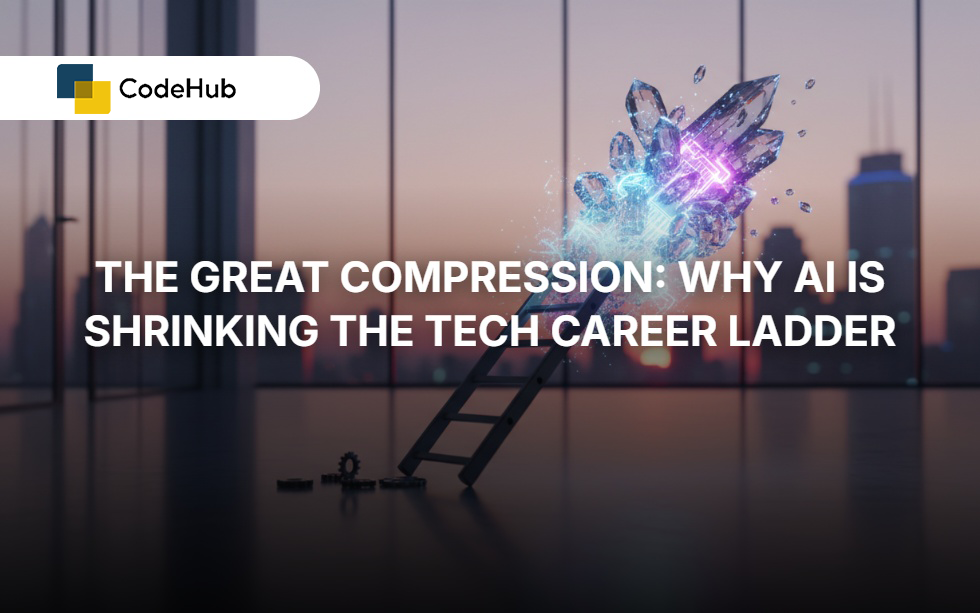
For decades, the path from Junior to Senior Engineer was a decade-long grind of syntax mastery and architectural intuition. Today, Large Language Models (LLMs) are radically compressing that timeline. By automating the “grunt work” of software development, AI is challenging the traditional definitions of seniority and flattening the tech hierarchy.
The Erosion of the Middle
AI is rapidly commoditizing the technical skills that once defined the transition from a junior to a mid-level developer. Tasks like writing boilerplate, debugging legacy code, and generating documentation are now instantaneous.
The New Benchmarks of Seniority
As the technical barrier to entry drops, the “Senior” label is shifting away from coding proficiency toward higher-level competencies:
- System Orchestration: Moving from writing functions to designing resilient, AI-integrated architectures.
- Strategic Problem Solving: Focusing on why we build, rather than just how we code.
- Risk Mitigation: Identifying the subtle hallucinations and security flaws inherent in AI-generated output.
A Flatter Future
The traditional ten-step career ladder is becoming a short, high-impact platform. When an entry-level developer with an AI assistant can match the output of a veteran, “years of experience” loses its status as a primary metric.
In this new era, seniority is no longer measured by syntax mastery, but by the ability to direct machine intelligence toward complex business goals. The ladder isn’t disappearing; it’s just getting a lot shorter.